Related features
API testing in a Flow
Call GET, POST, PUT, PATCH, or DELETE in the same Flow as your browser steps. Store JSON as Values and assert what comes back.
Run recipes
Create reusable run configurations to test different environments, tags, and value sets. Trigger complex test selections without editing code or pipelines.
Fullscreen JSON Editor
Expand any JSON field in DoesQA into a fullscreen editor. Built for large payloads, nested objects and complex configuration.
Dynamic values
Dynamic values for flexible, scalable test automation
Modern applications rely on changing data. Your test automation should too.
DoesQA gives you a complete value system that allows you to inject dynamic data into any test, at any stage.
Dynamic values for flexible, scalable test automation
Use built-in dynamic values, environment-specific variables, or create your own custom values to power smarter, more resilient automation.
Dynamic values reduce brittleness and help you avoid hard-coded data that breaks over time.
Environment variables
Current date and time
Relative dates
Random strings and numbers
Generated test data
Create unique users
Avoid collisions in test environments
Simulate realistic scenarios
Validate date-sensitive logic
Run repeatable yet non-static tests
Created at account level
Scoped to environments
Built-in dynamic data out of the box
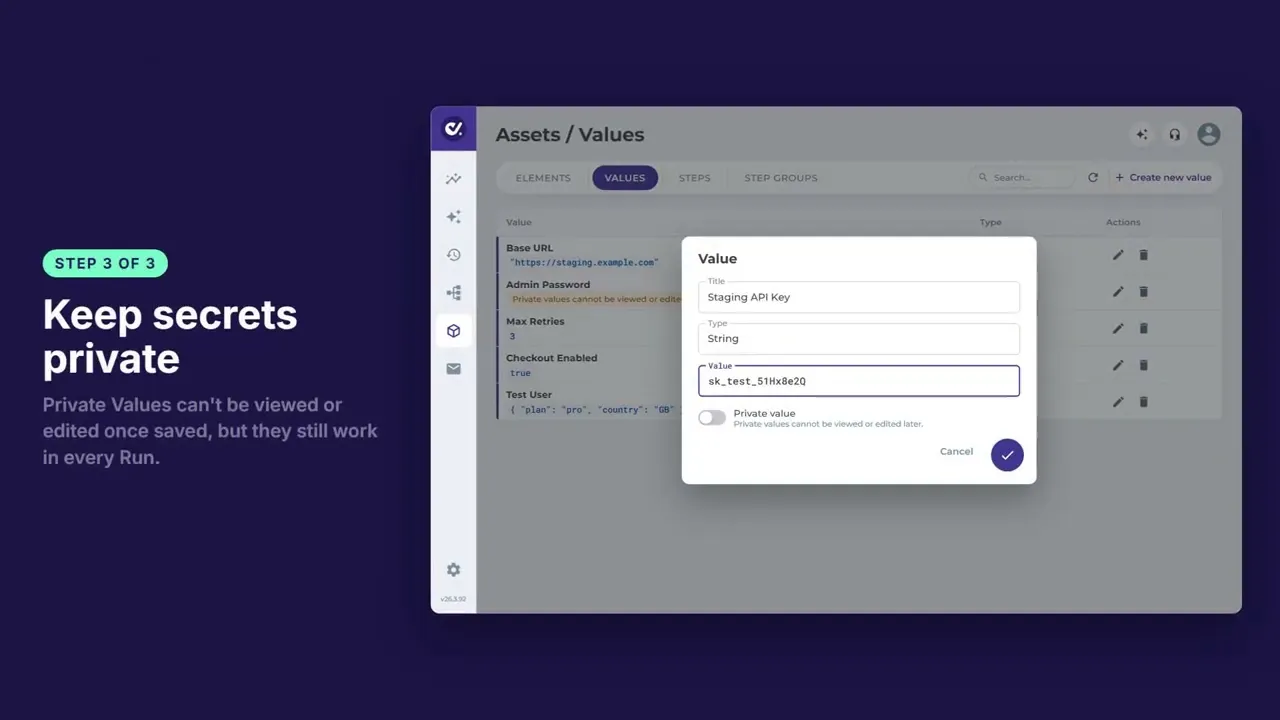
DoesQA includes a powerful Value Store that acts as a centralised data layer for your automation.
This allows you to build flows once and run them in multiple contexts without duplication.
The Value Store: one source of truth
Dev, staging, and production can share the same flow
Currency or language variants can be switched instantly
Dynamic values in recipes and CI/CD
Feature flags can be toggled without editing the flow
The system uses a hierarchical merge approach. Any values provided at run time override stored values, while unspecified values continue to inherit from the Value Store.
Create your own values
This keeps configuration flexible without losing structure.
Dynamic values become even more powerful when combined with:
Smarter data, stronger tests
You can pass arrays of value sets to trigger multiple runs automatically, each with different configurations.
All without duplicating flows or editing pipelines.
This allows your automation to adapt dynamically as it runs.
For complex applications, dynamic values are the difference between rigid tests and intelligent automation.
