DoesQA vs Playwright: the same test compared

Want to see the same test in DoesQA and Playwright?
Cool. Pick a journey real humans do: create an account with email verification, or reset a forgotten password with email. Same door in. Same "you're in" screen out. Two branches that start together and finish together.
In DoesQA this can be one Flow. Shared Open. Shared first clicks. Split. Join. Email inbox included.
In Playwright that is... well. Selectors. Page objects. A mail helper you wired up at 11pm. A remote runner you do not fully control. And a second copy of half of that when the forgotten password path "is basically the same" until it isn't.
If you want hundreds of lines of code, a huge amount of duplication, and flaky runs on third-party remote runners, the choice is clear.
If you want solid, easy-to-maintain quality assurance, check out DoesQA.
The journey
One product surface. Two paths:
Register with email verification
Forgotten password with email reset
Both open the app, hit Register, confirm the Login / Register screen, then split. Both end on Welcome. In DoesQA that shape is a later split: shared start, two branches, one join.
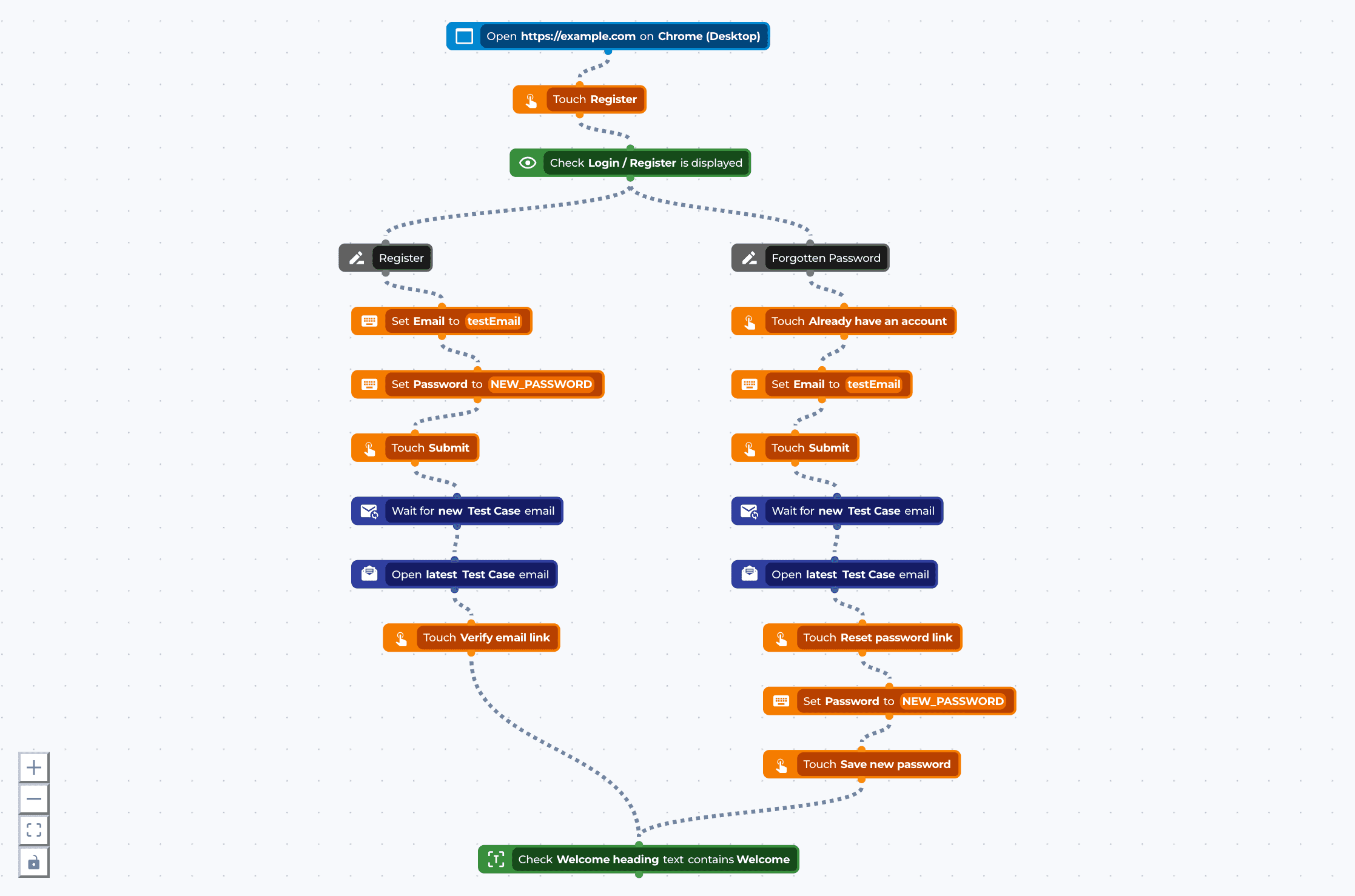
That canvas is the whole point. Shared start. Branch labels. Mail steps on both sides. One Welcome check at the bottom. Two Test Cases from one Flow.
How-to detail lives in the docs: registration and email verification and forgotten password.
The same test in DoesQA
Rough map of the Flow above:
Stage | What happens |
|---|---|
Shared start | Open |
Register branch | Set Email to |
Forgotten Password branch | Touch Already have an account. Set Email to |
Shared end | Check Welcome heading text contains Welcome. |
No custom mail server in the test. No second framework for inbox. The Test Case inbox is a first-class step. Selectors live in shared Elements. Change Email once; both branches pick it up.
That is what "same start, same end" looks like when the product was built for journeys, not for assembling a lab around a browser API.
The same test in Playwright
Here is a fair, slightly-better-than-average sketch of that same Flow. Page objects. A small mail helper. Two specs that share the start and still duplicate the glue.
// auth.pages.ts

import

{

Page
,

expect

}

from

'@playwright/test'
;

export

class
 AuthPages
{


constructor
(
private
 readonly page
:
 Page
)

{
}


async

open
(
)

{


await

this
.
page
.
goto
(
'https://example.com'
)
;


}


async

touchRegister
(
)

{


await

this
.
page
.
getByRole
(
'link'
,

{

name
:

'Register'

}
)
.
click
(
)
;


}


async

expectLoginOrRegister
(
)

{


await

expect
(
this
.
page
.
getByText
(
'Login / Register'
)
)
.
toBeVisible
(
)
;


}


async

touchAlreadyHaveAnAccount
(
)

{


await

this
.
page
.
getByRole
(
'link'
,

{

name
:

'Already have an account'

}
)
.
click
(
)
;


}


async

fillEmail
(
email
:
 string
)

{


await

this
.
page
.
getByLabel
(
'Email'
)
.
fill
(
email
)
;


}


async

fillPassword
(
password
:
 string
)

{


await

this
.
page
.
getByLabel
(
'Password'
)
.
fill
(
password
)
;


}


async

submit
(
)

{


await

this
.
page
.
getByRole
(
'button'
,

{

name
:

'Submit'

}
)
.
click
(
)
;


}


async

saveNewPassword
(
)

{


await

this
.
page
.
getByRole
(
'button'
,

{

name
:

'Save new password'

}
)
.
click
(
)
;


}


async

expectWelcome
(
)

{


await

expect
(
this
.
page
.
getByRole
(
'heading'
,

{

name
:

/Welcome/i

}
)
)
.
toBeVisible
(
)
;


}

}
// auth.pages.ts

import

{

Page
,

expect

}

from

'@playwright/test'
;

export

class
 AuthPages
{


constructor
(
private
 readonly page
:
 Page
)

{
}


async

open
(
)

{


await

this
.
page
.
goto
(
'https://example.com'
)
;


}


async

touchRegister
(
)

{


await

this
.
page
.
getByRole
(
'link'
,

{

name
:

'Register'

}
)
.
click
(
)
;


}


async

expectLoginOrRegister
(
)

{


await

expect
(
this
.
page
.
getByText
(
'Login / Register'
)
)
.
toBeVisible
(
)
;


}


async

touchAlreadyHaveAnAccount
(
)

{


await

this
.
page
.
getByRole
(
'link'
,

{

name
:

'Already have an account'

}
)
.
click
(
)
;


}


async

fillEmail
(
email
:
 string
)

{


await

this
.
page
.
getByLabel
(
'Email'
)
.
fill
(
email
)
;


}


async

fillPassword
(
password
:
 string
)

{


await

this
.
page
.
getByLabel
(
'Password'
)
.
fill
(
password
)
;


}


async

submit
(
)

{


await

this
.
page
.
getByRole
(
'button'
,

{

name
:

'Submit'

}
)
.
click
(
)
;


}


async

saveNewPassword
(
)

{


await

this
.
page
.
getByRole
(
'button'
,

{

name
:

'Save new password'

}
)
.
click
(
)
;


}


async

expectWelcome
(
)

{


await

expect
(
this
.
page
.
getByRole
(
'heading'
,

{

name
:

/Welcome/i

}
)
)
.
toBeVisible
(
)
;


}

}
// auth.pages.ts

import

{

Page
,

expect

}

from

'@playwright/test'
;

export

class
 AuthPages
{


constructor
(
private
 readonly page
:
 Page
)

{
}


async

open
(
)

{


await

this
.
page
.
goto
(
'https://example.com'
)
;


}


async

touchRegister
(
)

{


await

this
.
page
.
getByRole
(
'link'
,

{

name
:

'Register'

}
)
.
click
(
)
;


}


async

expectLoginOrRegister
(
)

{


await

expect
(
this
.
page
.
getByText
(
'Login / Register'
)
)
.
toBeVisible
(
)
;


}


async

touchAlreadyHaveAnAccount
(
)

{


await

this
.
page
.
getByRole
(
'link'
,

{

name
:

'Already have an account'

}
)
.
click
(
)
;


}


async

fillEmail
(
email
:
 string
)

{


await

this
.
page
.
getByLabel
(
'Email'
)
.
fill
(
email
)
;


}


async

fillPassword
(
password
:
 string
)

{


await

this
.
page
.
getByLabel
(
'Password'
)
.
fill
(
password
)
;


}


async

submit
(
)

{


await

this
.
page
.
getByRole
(
'button'
,

{

name
:

'Submit'

}
)
.
click
(
)
;


}


async

saveNewPassword
(
)

{


await

this
.
page
.
getByRole
(
'button'
,

{

name
:

'Save new password'

}
)
.
click
(
)
;


}


async

expectWelcome
(
)

{


await

expect
(
this
.
page
.
getByRole
(
'heading'
,

{

name
:

/Welcome/i

}
)
)
.
toBeVisible
(
)
;


}

}
// auth.pages.ts

import

{

Page
,

expect

}

from

'@playwright/test'
;

export

class
 AuthPages
{


constructor
(
private
 readonly page
:
 Page
)

{
}


async

open
(
)

{


await

this
.
page
.
goto
(
'https://example.com'
)
;


}


async

touchRegister
(
)

{


await

this
.
page
.
getByRole
(
'link'
,

{

name
:

'Register'

}
)
.
click
(
)
;


}


async

expectLoginOrRegister
(
)

{


await

expect
(
this
.
page
.
getByText
(
'Login / Register'
)
)
.
toBeVisible
(
)
;


}


async

touchAlreadyHaveAnAccount
(
)

{


await

this
.
page
.
getByRole
(
'link'
,

{

name
:

'Already have an account'

}
)
.
click
(
)
;


}


async

fillEmail
(
email
:
 string
)

{


await

this
.
page
.
getByLabel
(
'Email'
)
.
fill
(
email
)
;


}


async

fillPassword
(
password
:
 string
)

{


await

this
.
page
.
getByLabel
(
'Password'
)
.
fill
(
password
)
;


}


async

submit
(
)

{


await

this
.
page
.
getByRole
(
'button'
,

{

name
:

'Submit'

}
)
.
click
(
)
;


}


async

saveNewPassword
(
)

{


await

this
.
page
.
getByRole
(
'button'
,

{

name
:

'Save new password'

}
)
.
click
(
)
;


}


async

expectWelcome
(
)

{


await

expect
(
this
.
page
.
getByRole
(
'heading'
,

{

name
:

/Welcome/i

}
)
)
.
toBeVisible
(
)
;


}

}
// auth.pages.ts

import

{

Page
,

expect

}

from

'@playwright/test'
;

export

class
 AuthPages
{


constructor
(
private
 readonly page
:
 Page
)

{
}


async

open
(
)

{


await

this
.
page
.
goto
(
'https://example.com'
)
;


}


async

touchRegister
(
)

{


await

this
.
page
.
getByRole
(
'link'
,

{

name
:

'Register'

}
)
.
click
(
)
;


}


async

expectLoginOrRegister
(
)

{


await

expect
(
this
.
page
.
getByText
(
'Login / Register'
)
)
.
toBeVisible
(
)
;


}


async

touchAlreadyHaveAnAccount
(
)

{


await

this
.
page
.
getByRole
(
'link'
,

{

name
:

'Already have an account'

}
)
.
click
(
)
;


}


async

fillEmail
(
email
:
 string
)

{


await

this
.
page
.
getByLabel
(
'Email'
)
.
fill
(
email
)
;


}


async

fillPassword
(
password
:
 string
)

{


await

this
.
page
.
getByLabel
(
'Password'
)
.
fill
(
password
)
;


}


async

submit
(
)

{


await

this
.
page
.
getByRole
(
'button'
,

{

name
:

'Submit'

}
)
.
click
(
)
;


}


async

saveNewPassword
(
)

{


await

this
.
page
.
getByRole
(
'button'
,

{

name
:

'Save new password'

}
)
.
click
(
)
;


}


async

expectWelcome
(
)

{


await

expect
(
this
.
page
.
getByRole
(
'heading'
,

{

name
:

/Welcome/i

}
)
)
.
toBeVisible
(
)
;


}

}
// auth.pages.ts

import

{

Page
,

expect

}

from

'@playwright/test'
;

export

class
 AuthPages
{


constructor
(
private
 readonly page
:
 Page
)

{
}


async

open
(
)

{


await

this
.
page
.
goto
(
'https://example.com'
)
;


}


async

touchRegister
(
)

{


await

this
.
page
.
getByRole
(
'link'
,

{

name
:

'Register'

}
)
.
click
(
)
;


}


async

expectLoginOrRegister
(
)

{


await

expect
(
this
.
page
.
getByText
(
'Login / Register'
)
)
.
toBeVisible
(
)
;


}


async

touchAlreadyHaveAnAccount
(
)

{


await

this
.
page
.
getByRole
(
'link'
,

{

name
:

'Already have an account'

}
)
.
click
(
)
;


}


async

fillEmail
(
email
:
 string
)

{


await

this
.
page
.
getByLabel
(
'Email'
)
.
fill
(
email
)
;


}


async

fillPassword
(
password
:
 string
)

{


await

this
.
page
.
getByLabel
(
'Password'
)
.
fill
(
password
)
;


}


async

submit
(
)

{


await

this
.
page
.
getByRole
(
'button'
,

{

name
:

'Submit'

}
)
.
click
(
)
;


}


async

saveNewPassword
(
)

{


await

this
.
page
.
getByRole
(
'button'
,

{

name
:

'Save new password'

}
)
.
click
(
)
;


}


async

expectWelcome
(
)

{


await

expect
(
this
.
page
.
getByRole
(
'heading'
,

{

name
:

/Welcome/i

}
)
)
.
toBeVisible
(
)
;


}

}
// auth.pages.ts

import

{

Page
,

expect

}

from

'@playwright/test'
;

export

class
 AuthPages
{


constructor
(
private
 readonly page
:
 Page
)

{
}


async

open
(
)

{


await

this
.
page
.
goto
(
'https://example.com'
)
;


}


async

touchRegister
(
)

{


await

this
.
page
.
getByRole
(
'link'
,

{

name
:

'Register'

}
)
.
click
(
)
;


}


async

expectLoginOrRegister
(
)

{


await

expect
(
this
.
page
.
getByText
(
'Login / Register'
)
)
.
toBeVisible
(
)
;


}


async

touchAlreadyHaveAnAccount
(
)

{


await

this
.
page
.
getByRole
(
'link'
,

{

name
:

'Already have an account'

}
)
.
click
(
)
;


}


async

fillEmail
(
email
:
 string
)

{


await

this
.
page
.
getByLabel
(
'Email'
)
.
fill
(
email
)
;


}


async

fillPassword
(
password
:
 string
)

{


await

this
.
page
.
getByLabel
(
'Password'
)
.
fill
(
password
)
;


}


async

submit
(
)

{


await

this
.
page
.
getByRole
(
'button'
,

{

name
:

'Submit'

}
)
.
click
(
)
;


}


async

saveNewPassword
(
)

{


await

this
.
page
.
getByRole
(
'button'
,

{

name
:

'Save new password'

}
)
.
click
(
)
;


}


async

expectWelcome
(
)

{


await

expect
(
this
.
page
.
getByRole
(
'heading'
,

{

name
:

/Welcome/i

}
)
)
.
toBeVisible
(
)
;


}

}
// auth.pages.ts

import

{

Page
,

expect

}

from

'@playwright/test'
;

export

class
 AuthPages
{


constructor
(
private
 readonly page
:
 Page
)

{
}


async

open
(
)

{


await

this
.
page
.
goto
(
'https://example.com'
)
;


}


async

touchRegister
(
)

{


await

this
.
page
.
getByRole
(
'link'
,

{

name
:

'Register'

}
)
.
click
(
)
;


}


async

expectLoginOrRegister
(
)

{


await

expect
(
this
.
page
.
getByText
(
'Login / Register'
)
)
.
toBeVisible
(
)
;


}


async

touchAlreadyHaveAnAccount
(
)

{


await

this
.
page
.
getByRole
(
'link'
,

{

name
:

'Already have an account'

}
)
.
click
(
)
;


}


async

fillEmail
(
email
:
 string
)

{


await

this
.
page
.
getByLabel
(
'Email'
)
.
fill
(
email
)
;


}


async

fillPassword
(
password
:
 string
)

{


await

this
.
page
.
getByLabel
(
'Password'
)
.
fill
(
password
)
;


}


async

submit
(
)

{


await

this
.
page
.
getByRole
(
'button'
,

{

name
:

'Submit'

}
)
.
click
(
)
;


}


async

saveNewPassword
(
)

{


await

this
.
page
.
getByRole
(
'button'
,

{

name
:

'Save new password'

}
)
.
click
(
)
;


}


async

expectWelcome
(
)

{


await

expect
(
this
.
page
.
getByRole
(
'heading'
,

{

name
:

/Welcome/i

}
)
)
.
toBeVisible
(
)
;


}

}
// auth.pages.ts

import

{

Page
,

expect

}

from

'@playwright/test'
;

export

class
 AuthPages
{


constructor
(
private
 readonly page
:
 Page
)

{
}


async

open
(
)

{


await

this
.
page
.
goto
(
'https://example.com'
)
;


}


async

touchRegister
(
)

{


await

this
.
page
.
getByRole
(
'link'
,

{

name
:

'Register'

}
)
.
click
(
)
;


}


async

expectLoginOrRegister
(
)

{


await

expect
(
this
.
page
.
getByText
(
'Login / Register'
)
)
.
toBeVisible
(
)
;


}


async

touchAlreadyHaveAnAccount
(
)

{


await

this
.
page
.
getByRole
(
'link'
,

{

name
:

'Already have an account'

}
)
.
click
(
)
;


}


async

fillEmail
(
email
:
 string
)

{


await

this
.
page
.
getByLabel
(
'Email'
)
.
fill
(
email
)
;


}


async

fillPassword
(
password
:
 string
)

{


await

this
.
page
.
getByLabel
(
'Password'
)
.
fill
(
password
)
;


}


async

submit
(
)

{


await

this
.
page
.
getByRole
(
'button'
,

{

name
:

'Submit'

}
)
.
click
(
)
;


}


async

saveNewPassword
(
)

{


await

this
.
page
.
getByRole
(
'button'
,

{

name
:

'Save new password'

}
)
.
click
(
)
;


}


async

expectWelcome
(
)

{


await

expect
(
this
.
page
.
getByRole
(
'heading'
,

{

name
:

/Welcome/i

}
)
)
.
toBeVisible
(
)
;


}

}
// mail.ts

// "Slightly better than average" still means you own this.

export

async

function

waitForNewMessage
(
inboxId
:
 string
)

{


// poll your mail API / Mailosaur / custom inbox service

}

export

async

function

openLatestAndClick
(
linkText
:
 RegExp
)

{


// fetch HTML, find anchor, return href for page.goto

}
// mail.ts

// "Slightly better than average" still means you own this.

export

async

function

waitForNewMessage
(
inboxId
:
 string
)

{


// poll your mail API / Mailosaur / custom inbox service

}

export

async

function

openLatestAndClick
(
linkText
:
 RegExp
)

{


// fetch HTML, find anchor, return href for page.goto

}
// mail.ts

// "Slightly better than average" still means you own this.

export

async

function

waitForNewMessage
(
inboxId
:
 string
)

{


// poll your mail API / Mailosaur / custom inbox service

}

export

async

function

openLatestAndClick
(
linkText
:
 RegExp
)

{


// fetch HTML, find anchor, return href for page.goto

}
// mail.ts

// "Slightly better than average" still means you own this.

export

async

function

waitForNewMessage
(
inboxId
:
 string
)

{


// poll your mail API / Mailosaur / custom inbox service

}

export

async

function

openLatestAndClick
(
linkText
:
 RegExp
)

{


// fetch HTML, find anchor, return href for page.goto

}
// mail.ts

// "Slightly better than average" still means you own this.

export

async

function

waitForNewMessage
(
inboxId
:
 string
)

{


// poll your mail API / Mailosaur / custom inbox service

}

export

async

function

openLatestAndClick
(
linkText
:
 RegExp
)

{


// fetch HTML, find anchor, return href for page.goto

}
// mail.ts

// "Slightly better than average" still means you own this.

export

async

function

waitForNewMessage
(
inboxId
:
 string
)

{


// poll your mail API / Mailosaur / custom inbox service

}

export

async

function

openLatestAndClick
(
linkText
:
 RegExp
)

{


// fetch HTML, find anchor, return href for page.goto

}
// mail.ts

// "Slightly better than average" still means you own this.

export

async

function

waitForNewMessage
(
inboxId
:
 string
)

{


// poll your mail API / Mailosaur / custom inbox service

}

export

async

function

openLatestAndClick
(
linkText
:
 RegExp
)

{


// fetch HTML, find anchor, return href for page.goto

}
// mail.ts

// "Slightly better than average" still means you own this.

export

async

function

waitForNewMessage
(
inboxId
:
 string
)

{


// poll your mail API / Mailosaur / custom inbox service

}

export

async

function

openLatestAndClick
(
linkText
:
 RegExp
)

{


// fetch HTML, find anchor, return href for page.goto

}
// mail.ts

// "Slightly better than average" still means you own this.

export

async

function

waitForNewMessage
(
inboxId
:
 string
)

{


// poll your mail API / Mailosaur / custom inbox service

}

export

async

function

openLatestAndClick
(
linkText
:
 RegExp
)

{


// fetch HTML, find anchor, return href for page.goto

}
// register.spec.ts

import

{

test

}

from

'@playwright/test'
;

import

{

AuthPages

}

from

'./auth.pages'
;

import

{

waitForNewMessage
,

openLatestAndClick

}

from

'./mail'
;

test
(
'register with email verification'
,

async

(
{

page

}
)

=>

{


const

auth
 =
new

AuthPages
(
page
)
;


const

email
 =
`user+
${
Date
.
now
(
)
}
@mail.test`
;


const

password
 =
process
.
env
.
NEW_PASSWORD
!
;


await

auth
.
open
(
)
;


await

auth
.
touchRegister
(
)
;


await

auth
.
expectLoginOrRegister
(
)
;


await

auth
.
fillEmail
(
email
)
;


await

auth
.
fillPassword
(
password
)
;


await

auth
.
submit
(
)
;


await

waitForNewMessage
(
email
)
;


const

verifyUrl
 =
await

openLatestAndClick
(
/verify|confirm/i
)
;


await

page
.
goto
(
verifyUrl
)
;


await

auth
.
expectWelcome
(
)
;

}
)
;
// register.spec.ts

import

{

test

}

from

'@playwright/test'
;

import

{

AuthPages

}

from

'./auth.pages'
;

import

{

waitForNewMessage
,

openLatestAndClick

}

from

'./mail'
;

test
(
'register with email verification'
,

async

(
{

page

}
)

=>

{


const

auth
 =
new

AuthPages
(
page
)
;


const

email
 =
`user+
${
Date
.
now
(
)
}
@mail.test`
;


const

password
 =
process
.
env
.
NEW_PASSWORD
!
;


await

auth
.
open
(
)
;


await

auth
.
touchRegister
(
)
;


await

auth
.
expectLoginOrRegister
(
)
;


await

auth
.
fillEmail
(
email
)
;


await

auth
.
fillPassword
(
password
)
;


await

auth
.
submit
(
)
;


await

waitForNewMessage
(
email
)
;


const

verifyUrl
 =
await

openLatestAndClick
(
/verify|confirm/i
)
;


await

page
.
goto
(
verifyUrl
)
;


await

auth
.
expectWelcome
(
)
;

}
)
;
// register.spec.ts

import

{

test

}

from

'@playwright/test'
;

import

{

AuthPages

}

from

'./auth.pages'
;

import

{

waitForNewMessage
,

openLatestAndClick

}

from

'./mail'
;

test
(
'register with email verification'
,

async

(
{

page

}
)

=>

{


const

auth
 =
new

AuthPages
(
page
)
;


const

email
 =
`user+
${
Date
.
now
(
)
}
@mail.test`
;


const

password
 =
process
.
env
.
NEW_PASSWORD
!
;


await

auth
.
open
(
)
;


await

auth
.
touchRegister
(
)
;


await

auth
.
expectLoginOrRegister
(
)
;


await

auth
.
fillEmail
(
email
)
;


await

auth
.
fillPassword
(
password
)
;


await

auth
.
submit
(
)
;


await

waitForNewMessage
(
email
)
;


const

verifyUrl
 =
await

openLatestAndClick
(
/verify|confirm/i
)
;


await

page
.
goto
(
verifyUrl
)
;


await

auth
.
expectWelcome
(
)
;

}
)
;
// register.spec.ts

import

{

test

}

from

'@playwright/test'
;

import

{

AuthPages

}

from

'./auth.pages'
;

import

{

waitForNewMessage
,

openLatestAndClick

}

from

'./mail'
;

test
(
'register with email verification'
,

async

(
{

page

}
)

=>

{


const

auth
 =
new

AuthPages
(
page
)
;


const

email
 =
`user+
${
Date
.
now
(
)
}
@mail.test`
;


const

password
 =
process
.
env
.
NEW_PASSWORD
!
;


await

auth
.
open
(
)
;


await

auth
.
touchRegister
(
)
;


await

auth
.
expectLoginOrRegister
(
)
;


await

auth
.
fillEmail
(
email
)
;


await

auth
.
fillPassword
(
password
)
;


await

auth
.
submit
(
)
;


await

waitForNewMessage
(
email
)
;


const

verifyUrl
 =
await

openLatestAndClick
(
/verify|confirm/i
)
;


await

page
.
goto
(
verifyUrl
)
;


await

auth
.
expectWelcome
(
)
;

}
)
;
// register.spec.ts

import

{

test

}

from

'@playwright/test'
;

import

{

AuthPages

}

from

'./auth.pages'
;

import

{

waitForNewMessage
,

openLatestAndClick

}

from

'./mail'
;

test
(
'register with email verification'
,

async

(
{

page

}
)

=>

{


const

auth
 =
new

AuthPages
(
page
)
;


const

email
 =
`user+
${
Date
.
now
(
)
}
@mail.test`
;


const

password
 =
process
.
env
.
NEW_PASSWORD
!
;


await

auth
.
open
(
)
;


await

auth
.
touchRegister
(
)
;


await

auth
.
expectLoginOrRegister
(
)
;


await

auth
.
fillEmail
(
email
)
;


await

auth
.
fillPassword
(
password
)
;


await

auth
.
submit
(
)
;


await

waitForNewMessage
(
email
)
;


const

verifyUrl
 =
await

openLatestAndClick
(
/verify|confirm/i
)
;


await

page
.
goto
(
verifyUrl
)
;


await

auth
.
expectWelcome
(
)
;

}
)
;
// register.spec.ts

import

{

test

}

from

'@playwright/test'
;

import

{

AuthPages

}

from

'./auth.pages'
;

import

{

waitForNewMessage
,

openLatestAndClick

}

from

'./mail'
;

test
(
'register with email verification'
,

async

(
{

page

}
)

=>

{


const

auth
 =
new

AuthPages
(
page
)
;


const

email
 =
`user+
${
Date
.
now
(
)
}
@mail.test`
;


const

password
 =
process
.
env
.
NEW_PASSWORD
!
;


await

auth
.
open
(
)
;


await

auth
.
touchRegister
(
)
;


await

auth
.
expectLoginOrRegister
(
)
;


await

auth
.
fillEmail
(
email
)
;


await

auth
.
fillPassword
(
password
)
;


await

auth
.
submit
(
)
;


await

waitForNewMessage
(
email
)
;


const

verifyUrl
 =
await

openLatestAndClick
(
/verify|confirm/i
)
;


await

page
.
goto
(
verifyUrl
)
;


await

auth
.
expectWelcome
(
)
;

}
)
;
// register.spec.ts

import

{

test

}

from

'@playwright/test'
;

import

{

AuthPages

}

from

'./auth.pages'
;

import

{

waitForNewMessage
,

openLatestAndClick

}

from

'./mail'
;

test
(
'register with email verification'
,

async

(
{

page

}
)

=>

{


const

auth
 =
new

AuthPages
(
page
)
;


const

email
 =
`user+
${
Date
.
now
(
)
}
@mail.test`
;


const

password
 =
process
.
env
.
NEW_PASSWORD
!
;


await

auth
.
open
(
)
;


await

auth
.
touchRegister
(
)
;


await

auth
.
expectLoginOrRegister
(
)
;


await

auth
.
fillEmail
(
email
)
;


await

auth
.
fillPassword
(
password
)
;


await

auth
.
submit
(
)
;


await

waitForNewMessage
(
email
)
;


const

verifyUrl
 =
await

openLatestAndClick
(
/verify|confirm/i
)
;


await

page
.
goto
(
verifyUrl
)
;


await

auth
.
expectWelcome
(
)
;

}
)
;
// register.spec.ts

import

{

test

}

from

'@playwright/test'
;

import

{

AuthPages

}

from

'./auth.pages'
;

import

{

waitForNewMessage
,

openLatestAndClick

}

from

'./mail'
;

test
(
'register with email verification'
,

async

(
{

page

}
)

=>

{


const

auth
 =
new

AuthPages
(
page
)
;


const

email
 =
`user+
${
Date
.
now
(
)
}
@mail.test`
;


const

password
 =
process
.
env
.
NEW_PASSWORD
!
;


await

auth
.
open
(
)
;


await

auth
.
touchRegister
(
)
;


await

auth
.
expectLoginOrRegister
(
)
;


await

auth
.
fillEmail
(
email
)
;


await

auth
.
fillPassword
(
password
)
;


await

auth
.
submit
(
)
;


await

waitForNewMessage
(
email
)
;


const

verifyUrl
 =
await

openLatestAndClick
(
/verify|confirm/i
)
;


await

page
.
goto
(
verifyUrl
)
;


await

auth
.
expectWelcome
(
)
;

}
)
;
// register.spec.ts

import

{

test

}

from

'@playwright/test'
;

import

{

AuthPages

}

from

'./auth.pages'
;

import

{

waitForNewMessage
,

openLatestAndClick

}

from

'./mail'
;

test
(
'register with email verification'
,

async

(
{

page

}
)

=>

{


const

auth
 =
new

AuthPages
(
page
)
;


const

email
 =
`user+
${
Date
.
now
(
)
}
@mail.test`
;


const

password
 =
process
.
env
.
NEW_PASSWORD
!
;


await

auth
.
open
(
)
;


await

auth
.
touchRegister
(
)
;


await

auth
.
expectLoginOrRegister
(
)
;


await

auth
.
fillEmail
(
email
)
;


await

auth
.
fillPassword
(
password
)
;


await

auth
.
submit
(
)
;


await

waitForNewMessage
(
email
)
;


const

verifyUrl
 =
await

openLatestAndClick
(
/verify|confirm/i
)
;


await

page
.
goto
(
verifyUrl
)
;


await

auth
.
expectWelcome
(
)
;

}
)
;
// forgotten-password.spec.ts

import

{

test

}

from

'@playwright/test'
;

import

{

AuthPages

}

from

'./auth.pages'
;

import

{

waitForNewMessage
,

openLatestAndClick

}

from

'./mail'
;

test
(
'forgotten password with email'
,

async

(
{

page

}
)

=>

{


const

auth
 =
new

AuthPages
(
page
)
;


const

email
 =
process
.
env
.
EXISTING_USER_EMAIL
!
;


const

password
 =
process
.
env
.
NEW_PASSWORD
!
;


await

auth
.
open
(
)
;


await

auth
.
touchRegister
(
)
;


await

auth
.
expectLoginOrRegister
(
)
;


await

auth
.
touchAlreadyHaveAnAccount
(
)
;


await

auth
.
fillEmail
(
email
)
;


await

auth
.
submit
(
)
;


await

waitForNewMessage
(
email
)
;


const

resetUrl
 =
await

openLatestAndClick
(
/reset|password/i
)
;


await

page
.
goto
(
resetUrl
)
;


await

auth
.
fillPassword
(
password
)
;


await

auth
.
saveNewPassword
(
)
;


await

auth
.
expectWelcome
(
)
;

}
)
;
// forgotten-password.spec.ts

import

{

test

}

from

'@playwright/test'
;

import

{

AuthPages

}

from

'./auth.pages'
;

import

{

waitForNewMessage
,

openLatestAndClick

}

from

'./mail'
;

test
(
'forgotten password with email'
,

async

(
{

page

}
)

=>

{


const

auth
 =
new

AuthPages
(
page
)
;


const

email
 =
process
.
env
.
EXISTING_USER_EMAIL
!
;


const

password
 =
process
.
env
.
NEW_PASSWORD
!
;


await

auth
.
open
(
)
;


await

auth
.
touchRegister
(
)
;


await

auth
.
expectLoginOrRegister
(
)
;


await

auth
.
touchAlreadyHaveAnAccount
(
)
;


await

auth
.
fillEmail
(
email
)
;


await

auth
.
submit
(
)
;


await

waitForNewMessage
(
email
)
;


const

resetUrl
 =
await

openLatestAndClick
(
/reset|password/i
)
;


await

page
.
goto
(
resetUrl
)
;


await

auth
.
fillPassword
(
password
)
;


await

auth
.
saveNewPassword
(
)
;


await

auth
.
expectWelcome
(
)
;

}
)
;
// forgotten-password.spec.ts

import

{

test

}

from

'@playwright/test'
;

import

{

AuthPages

}

from

'./auth.pages'
;

import

{

waitForNewMessage
,

openLatestAndClick

}

from

'./mail'
;

test
(
'forgotten password with email'
,

async

(
{

page

}
)

=>

{


const

auth
 =
new

AuthPages
(
page
)
;


const

email
 =
process
.
env
.
EXISTING_USER_EMAIL
!
;


const

password
 =
process
.
env
.
NEW_PASSWORD
!
;


await

auth
.
open
(
)
;


await

auth
.
touchRegister
(
)
;


await

auth
.
expectLoginOrRegister
(
)
;


await

auth
.
touchAlreadyHaveAnAccount
(
)
;


await

auth
.
fillEmail
(
email
)
;


await

auth
.
submit
(
)
;


await

waitForNewMessage
(
email
)
;


const

resetUrl
 =
await

openLatestAndClick
(
/reset|password/i
)
;


await

page
.
goto
(
resetUrl
)
;


await

auth
.
fillPassword
(
password
)
;


await

auth
.
saveNewPassword
(
)
;


await

auth
.
expectWelcome
(
)
;

}
)
;
// forgotten-password.spec.ts

import

{

test

}

from

'@playwright/test'
;

import

{

AuthPages

}

from

'./auth.pages'
;

import

{

waitForNewMessage
,

openLatestAndClick

}

from

'./mail'
;

test
(
'forgotten password with email'
,

async

(
{

page

}
)

=>

{


const

auth
 =
new

AuthPages
(
page
)
;


const

email
 =
process
.
env
.
EXISTING_USER_EMAIL
!
;


const

password
 =
process
.
env
.
NEW_PASSWORD
!
;


await

auth
.
open
(
)
;


await

auth
.
touchRegister
(
)
;


await

auth
.
expectLoginOrRegister
(
)
;


await

auth
.
touchAlreadyHaveAnAccount
(
)
;


await

auth
.
fillEmail
(
email
)
;


await

auth
.
submit
(
)
;


await

waitForNewMessage
(
email
)
;


const

resetUrl
 =
await

openLatestAndClick
(
/reset|password/i
)
;


await

page
.
goto
(
resetUrl
)
;


await

auth
.
fillPassword
(
password
)
;


await

auth
.
saveNewPassword
(
)
;


await

auth
.
expectWelcome
(
)
;

}
)
;
// forgotten-password.spec.ts

import

{

test

}

from

'@playwright/test'
;

import

{

AuthPages

}

from

'./auth.pages'
;

import

{

waitForNewMessage
,

openLatestAndClick

}

from

'./mail'
;

test
(
'forgotten password with email'
,

async

(
{

page

}
)

=>

{


const

auth
 =
new

AuthPages
(
page
)
;


const

email
 =
process
.
env
.
EXISTING_USER_EMAIL
!
;


const

password
 =
process
.
env
.
NEW_PASSWORD
!
;


await

auth
.
open
(
)
;


await

auth
.
touchRegister
(
)
;


await

auth
.
expectLoginOrRegister
(
)
;


await

auth
.
touchAlreadyHaveAnAccount
(
)
;


await

auth
.
fillEmail
(
email
)
;


await

auth
.
submit
(
)
;


await

waitForNewMessage
(
email
)
;


const

resetUrl
 =
await

openLatestAndClick
(
/reset|password/i
)
;


await

page
.
goto
(
resetUrl
)
;


await

auth
.
fillPassword
(
password
)
;


await

auth
.
saveNewPassword
(
)
;


await

auth
.
expectWelcome
(
)
;

}
)
;
// forgotten-password.spec.ts

import

{

test

}

from

'@playwright/test'
;

import

{

AuthPages

}

from

'./auth.pages'
;

import

{

waitForNewMessage
,

openLatestAndClick

}

from

'./mail'
;

test
(
'forgotten password with email'
,

async

(
{

page

}
)

=>

{


const

auth
 =
new

AuthPages
(
page
)
;


const

email
 =
process
.
env
.
EXISTING_USER_EMAIL
!
;


const

password
 =
process
.
env
.
NEW_PASSWORD
!
;


await

auth
.
open
(
)
;


await

auth
.
touchRegister
(
)
;


await

auth
.
expectLoginOrRegister
(
)
;


await

auth
.
touchAlreadyHaveAnAccount
(
)
;


await

auth
.
fillEmail
(
email
)
;


await

auth
.
submit
(
)
;


await

waitForNewMessage
(
email
)
;


const

resetUrl
 =
await

openLatestAndClick
(
/reset|password/i
)
;


await

page
.
goto
(
resetUrl
)
;


await

auth
.
fillPassword
(
password
)
;


await

auth
.
saveNewPassword
(
)
;


await

auth
.
expectWelcome
(
)
;

}
)
;
// forgotten-password.spec.ts

import

{

test

}

from

'@playwright/test'
;

import

{

AuthPages

}

from

'./auth.pages'
;

import

{

waitForNewMessage
,

openLatestAndClick

}

from

'./mail'
;

test
(
'forgotten password with email'
,

async

(
{

page

}
)

=>

{


const

auth
 =
new

AuthPages
(
page
)
;


const

email
 =
process
.
env
.
EXISTING_USER_EMAIL
!
;


const

password
 =
process
.
env
.
NEW_PASSWORD
!
;


await

auth
.
open
(
)
;


await

auth
.
touchRegister
(
)
;


await

auth
.
expectLoginOrRegister
(
)
;


await

auth
.
touchAlreadyHaveAnAccount
(
)
;


await

auth
.
fillEmail
(
email
)
;


await

auth
.
submit
(
)
;


await

waitForNewMessage
(
email
)
;


const

resetUrl
 =
await

openLatestAndClick
(
/reset|password/i
)
;


await

page
.
goto
(
resetUrl
)
;


await

auth
.
fillPassword
(
password
)
;


await

auth
.
saveNewPassword
(
)
;


await

auth
.
expectWelcome
(
)
;

}
)
;
// forgotten-password.spec.ts

import

{

test

}

from

'@playwright/test'
;

import

{

AuthPages

}

from

'./auth.pages'
;

import

{

waitForNewMessage
,

openLatestAndClick

}

from

'./mail'
;

test
(
'forgotten password with email'
,

async

(
{

page

}
)

=>

{


const

auth
 =
new

AuthPages
(
page
)
;


const

email
 =
process
.
env
.
EXISTING_USER_EMAIL
!
;


const

password
 =
process
.
env
.
NEW_PASSWORD
!
;


await

auth
.
open
(
)
;


await

auth
.
touchRegister
(
)
;


await

auth
.
expectLoginOrRegister
(
)
;


await

auth
.
touchAlreadyHaveAnAccount
(
)
;


await

auth
.
fillEmail
(
email
)
;


await

auth
.
submit
(
)
;


await

waitForNewMessage
(
email
)
;


const

resetUrl
 =
await

openLatestAndClick
(
/reset|password/i
)
;


await

page
.
goto
(
resetUrl
)
;


await

auth
.
fillPassword
(
password
)
;


await

auth
.
saveNewPassword
(
)
;


await

auth
.
expectWelcome
(
)
;

}
)
;
// forgotten-password.spec.ts

import

{

test

}

from

'@playwright/test'
;

import

{

AuthPages

}

from

'./auth.pages'
;

import

{

waitForNewMessage
,

openLatestAndClick

}

from

'./mail'
;

test
(
'forgotten password with email'
,

async

(
{

page

}
)

=>

{


const

auth
 =
new

AuthPages
(
page
)
;


const

email
 =
process
.
env
.
EXISTING_USER_EMAIL
!
;


const

password
 =
process
.
env
.
NEW_PASSWORD
!
;


await

auth
.
open
(
)
;


await

auth
.
touchRegister
(
)
;


await

auth
.
expectLoginOrRegister
(
)
;


await

auth
.
touchAlreadyHaveAnAccount
(
)
;


await

auth
.
fillEmail
(
email
)
;


await

auth
.
submit
(
)
;


await

waitForNewMessage
(
email
)
;


const

resetUrl
 =
await

openLatestAndClick
(
/reset|password/i
)
;


await

page
.
goto
(
resetUrl
)
;


await

auth
.
fillPassword
(
password
)
;


await

auth
.
saveNewPassword
(
)
;


await

auth
.
expectWelcome
(
)
;

}
)
;
That is the polite version of the canvas you just looked at. You still have not counted CI config, parallel workers, the browser cloud bill, reporting, flake retries, and the meeting where someone asks why register is green while reset is "flaky again".
How long does this take?
Rough estimate, from scratch, for a very good Playwright developer who already knows the tooling: a day to a day and a half.
That is project setup, page objects, standing up a mail provider, wiring the helper, both paths green once, and the usual "why is the inbox empty" diversion. Not CI. Not a runner farm. Not the second week of flakes.
The same Flow in DoesQA, from a newly created blank account: about 10 minutes.
Open. Touch. Check. Branch. Mail steps. Welcome. Done. Hosted runners and Results are already there.
Playwright is good at driving a single browser. It is not a mail product, a runner product, a results product, or a maintenance product. Those arrive as extra code and extra vendors. See The Real Cost of Playwright and DoesQA compared.
Where DoesQA is better (and we're not shy about it)
Same journey. Look at the maintenance story.
Change | DoesQA | Playwright sketch above |
|---|---|---|
Email field selector moves | Update one Element | Hunt locators across pages and specs |
Verify link copy changes | Update one Element | Touch mail helper and both specs |
Shared start changes (Open / Register / Login screen) | Edit once on the Flow | Edit both specs and hope the page object still matches |
Add a third auth path | Another branch on the same Flow | Another spec file, more shared-but-not-shared glue |
Debug a fail | Step timeline, screenshot, video on the Run | Logs, your reporter, the runner vendor's UI |
DoesQA ships authoring, shared Steps, hosted runners, and Results as one platform. When something is wrong, it is DoesQA's problem to fix the platform. That is the difference between a Flow and a second development repo that needs to be maintained.
For more on the benefits of Codeless versus code: Codeless vs coded.
So... which one is the same test?
Both prove register and forgotten password.
Only one keeps the shared start and shared end as a single maintained object without creating a second engineering team.
If you want hundreds of lines of code, a huge amount of duplication, and flaky runs on third-party remote runners, Playwright is free. Help yourself.
If you want solid, easy-to-maintain quality assurance, start a DoesQA trial.